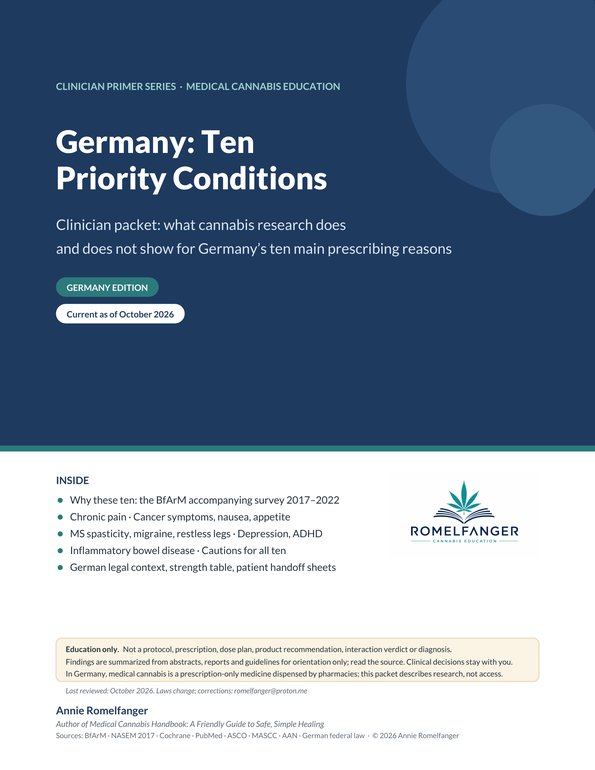
Cover of English - Germany Priority Conditions Packet
English
New

$19

  • 14 pages
  • 72 numbered sources
  • English edition

What published research does and does not show for the ten main reasons German physicians gave when prescribing cannabis medicines at statutory insurance expense (BfArM accompanying survey, 2017–2022): chronic pain, tumour disease, spasticity and multiple sclerosis, anorexia or wasting, depression, nausea or vomiting, migraine, inflammatory bowel disease, restless legs syndrome and ADHD. Plain evidence-strength labels, cautions for all ten, German legal context (MedCanG, insurance approval, the 2026 changes) and patient handoff sheets.

Written for Germany. Each condition gets a plain evidence label; for most of the ten the evidence is weak or mixed, and nothing here says cannabis cures them. Education only: no doses, no product recommendations, no drug-interaction verdicts. For the law, check official government sources.

Checkout and download happen on Payhip, our store. Questions before you buy? Email [email protected].

Patient or caregiver? Start with our page for you.

What this packet covers

The ten main reasons for insurer-approved cannabis prescriptions in Germany, in the packet’s five sections. Each summary gives the evidence-strength label the packet assigns, the German survey figures it cites, its key cautions and the number of sources it cites for that condition.

How the packet labels evidence strength

  • Some human evidence randomized trials suggest a benefit for the condition or a key symptom, usually small
  • Mixed trials conflict, are very small, or show benefit on some outcomes but not others
  • Little or none controlled trials found no benefit, or only case reports and observational data exist

Bottom line from the packet

Of the ten main reasons German physicians gave for prescribing cannabis, the trial evidence is best for chemotherapy-related nausea and patient-reported MS spasticity, and small but real on average for chronic, mainly neuropathic, pain. Migraine has one promising acute trial. The evidence for cancer pain, depression, ADHD and restless legs is weak or negative, and in IBD symptoms improve without less inflammation. The harm evidence (psychosis, use disorder, hyperemesis, driving) applies to all ten.

Chronic pain

Chronic pain

Evidence strength: Some human evidence (small)

Share of German records
The main reason in 76.4% of insurer-approved treatment records (12,842) in the BfArM accompanying survey, 2017–2022.
What the research shows
Many trials. A 2021 BMJ meta-analysis of 32 trials found a small increase in the share of patients reaching a meaningful improvement in pain; a 2026 update found small short-term improvements, mainly in neuropathic pain, with more adverse events. The 2026 Cochrane update on neuropathic pain found no clear evidence for THC-dominant medicines, and in randomized trials cannabinoids had little or no opioid-sparing effect.
Key cautions
  • Among 187 patients at three German pain centres, 29.9% met DSM-5 criteria for cannabis use disorder when all criteria were counted, and 2.1% when only problem behaviours were counted.
  • About one German treatment in three ended within a year, most often for lack of effect; the packet asks how benefit will be measured and when treatment will stop.

12 cited sources · packet refs [1, 8–18]

Cancer symptoms, nausea and appetite

Tumour disease (cancer)

Evidence strength: Little or none

Share of German records
A tumour disease was present in 14.5% of records (2,434). The BfArM report notes that cannabis was used for symptoms, not to treat the tumour.
What the research shows
No anti-tumour evidence: the National Academies (2017) found no or insufficient evidence for cancers, and ASCO (2024) recommends against cannabis or cannabinoids as a cancer-directed treatment outside a clinical trial. A 2023 Cochrane review found moderate-certainty evidence that nabiximols or THC added to opioids gave no clinically relevant benefit in opioid-refractory cancer pain.
Key cautions
  • MASCC found no high-quality evidence to recommend cannabis for psychological symptoms in people with cancer.
  • The packet asks whether the patient believes cannabis treats the cancer itself, and whether that has been discussed alongside oncology and palliative care.

7 cited sources · packet refs [1, 8, 19–23]

Nausea or vomiting

Evidence strength: Some human evidence (best of the ten)

Share of German records
The main reason in 2.2% of records (376).
What the research shows
The National Academies (2017) found conclusive or substantial evidence for oral cannabinoids in chemotherapy-induced nausea and vomiting, but the 23 trials in the 2015 Cochrane review date from 1975 to 1991, with no comparisons with modern antiemetics. Added to guideline antiemetics in a trial of 147 participants, oral THC:CBD raised complete response from 8% to 24%. ASCO (2024) says cannabinoids may be added for refractory chemotherapy nausea.
Key cautions
  • In the earlier phase II trial, 31% reported moderate or severe cannabinoid-related adverse events.
  • Regular use can itself cause cyclic vomiting (hyperemesis); stopping cannabis appears to be the most effective treatment.

8 cited sources · packet refs [1, 8, 19, 24–28]

Anorexia or wasting

Evidence strength: Mixed

Share of German records
The main reason in 5.1% of records (852), plus loss of appetite in a further 1.2% (198).
What the research shows
In AIDS-related weight loss, dronabinol improved appetite (38% vs 8%). In cancer, megestrol acetate improved appetite more than dronabinol, and in 243 patients with cancer cachexia neither cannabis extract nor THC differed from placebo. A pilot trial in lung cancer found nabilone increased caloric intake; evidence in anorexia nervosa is low quality.
Key cautions
  • The National Academies (2017) found no or insufficient evidence for cancer-associated anorexia cachexia syndrome and anorexia nervosa.
  • The packet asks which cause of weight loss is being treated, and whether nutrition support has been offered.

7 cited sources · packet refs [1, 8, 29–33]

Spasticity, migraine and restless legs

Spasticity and multiple sclerosis

Evidence strength: Some human evidence (patient-reported)

Share of German records
Spasticity was the main reason in 9.6% of records (1,607); multiple sclerosis was present in 5.9% (989).
What the research shows
The National Academies (2017) found conclusive or substantial evidence for oral cannabinoids in patient-reported MS spasticity. Cochrane (2022): compared with placebo, nabiximols probably reduces the severity of spasticity in the short term. In the CAMS trial, cannabinoids did not change the measured Ashworth score, but more patients reported less spasticity.
Key cautions
  • Cannabinoids may slightly increase stopping treatment because of adverse events (Cochrane 2022).
  • One trial randomized only early responders, and a 2024 crossover trial missed its primary measured-spasticity endpoint.

8 cited sources · packet refs [1, 8, 34–39]

Migraine

Evidence strength: Some human evidence (one acute trial)

Share of German records
The main reason in 2.0% of records (332); cluster headache in a further 0.6%.
What the research shows
In a 2026 randomized crossover trial (92 participants, 247 attacks), vaporized THC plus CBD beat placebo for pain relief and pain freedom at two hours; CBD-dominant cannabis was not better than placebo. The rest of the evidence is observational, and reviews call it promising but low quality.
Key cautions
  • In a case-referent study, medication-overuse headache was more common in cannabis users.
  • The packet asks how many days a month acute headache medication is used.

6 cited sources · packet refs [1, 40–44]

Restless legs syndrome

Evidence strength: Little or none

Share of German records
The main reason in 1.0% of records (165).
What the research shows
Case series only, and a review calls for controlled trials. In a post hoc analysis of 18 people with Parkinson’s disease and REM sleep behaviour disorder, cannabidiol did not differ from placebo for restless legs symptoms.
Key cautions
  • The cautions that apply to all ten (psychosis, use disorder, driving, pregnancy, medicine lists) apply here too.
  • The packet asks whether iron status and guideline treatments have been reviewed.

5 cited sources · packet refs [1, 45–48]

Depression and ADHD

Depression

Evidence strength: Little or none

Share of German records
The main reason in 2.8% of records (471). In 5,582 BfArM cases with a psychiatric diagnosis, most were somatoform disorders and most treatment targeted pain.
What the research shows
A 2019 review found scarce evidence that cannabinoids improve depressive disorders, and a 2026 update of 54 trials found no randomized evidence for depression and higher odds of adverse events. In a pragmatic trial, adults given a medical cannabis card right away had no improvement in depressive symptoms and more cannabis use disorder symptoms.
Key cautions
  • The National Academies (2017) found moderate evidence of a small increased risk of developing depressive disorders with cannabis use.
  • Adolescent cannabis use is linked with later depression and suicidal ideation.

7 cited sources · packet refs [1, 6, 8, 49–52]

ADHD

Evidence strength: Little or none

Share of German records
The main reason in 1.0% of records (163).
What the research shows
In one trial of 30 adults, a cannabinoid spray missed its primary cognitive endpoint. A 2023 scoping review of 39 studies found most reported worse or unchanged symptoms and did not recommend cannabis for ADHD; the 2026 psychiatric review found insufficient data.
Key cautions
  • The National Academies (2017) found moderate evidence that acute cannabis use impairs learning, memory and attention.
  • Earlier and heavier use carries more psychiatric risk.

5 cited sources · packet refs [1, 8, 50, 53, 54]

Inflammatory bowel disease

Inflammatory bowel disease

Evidence strength: Mixed (symptoms, not inflammation)

Share of German records
The main reason in 1.1% of records (182). In a German survey of 417 IBD patients, 4.3% currently used cannabis for their disease, and half of current users had not told their physician.
What the research shows
Cochrane (2018) found the effects of cannabis and cannabidiol in Crohn’s disease and ulcerative colitis unclear, from few and small trials. Later trials found clinical and quality-of-life improvement without improvement in endoscopic or inflammatory measures; a 2025 meta-analysis agreed.
Key cautions
  • In one cohort, using cannabis for more than six months was linked to surgery in Crohn’s disease.
  • Feeling better may mask continuing inflammation; the packet asks whether endoscopic and laboratory follow-up are on schedule.

10 cited sources · packet refs [1, 55–63]

Source counts are the numbered sources the packet cites in each condition’s section, including the BfArM accompanying survey [1]; the packet lists 72 in total, with PubMed citations verified by PMID in October 2026. Shares are of insurer-approved treatment records, 2017–2022, and more than one reason could be recorded. These summaries are condensed from the packet. Education only: no doses, product recommendations or drug-interaction verdicts.