← Australia

Australia edition

English - Australia Priority Conditions Packet

Education only: no diagnosis, dosing or drug-interaction advice. Always consult a clinician.

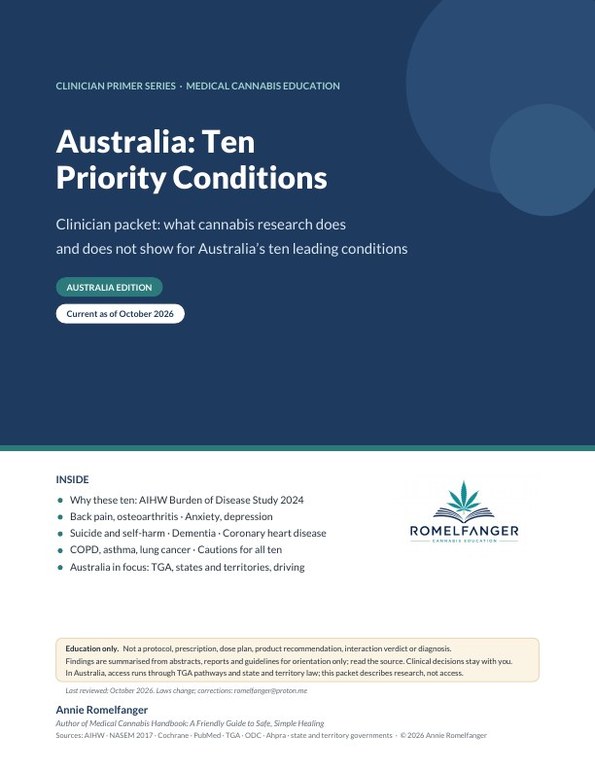
Cover of English - Australia Priority Conditions Packet
English
New

$19

  • 15 pages
  • 95 numbered sources
  • English edition

What published research does and does not show for Australia’s ten leading causes of disease burden (AIHW Australian Burden of Disease Study 2024): coronary heart disease, back pain, anxiety, depression, dementia, suicide and self-inflicted injuries, COPD, asthma, lung cancer and osteoarthritis. Plain evidence-strength labels, cautions for all ten, Australian legal context (TGA Special Access Scheme and Authorised Prescribers, pharmacy dispensing, state and territory rules including the ACT, drug driving in Victoria and Tasmania) and patient handoff sheets.

Written for Australia. The ten are Australia’s leading causes of disease burden. Each gets a plain evidence label; for several the research is mainly about harm, and nothing here says cannabis cures them. Education only: no doses, no product recommendations, no drug-interaction verdicts. For the law, check official government sources.

Checkout and download happen on Payhip, our store. Questions before you buy? Email [email protected].

Patient or caregiver? Start with our page for you.

What this packet covers

Australia’s ten leading causes of disease burden in 2024 (AIHW Australian Burden of Disease Study, age-standardised DALYs), in the packet’s six condition sections. Each summary gives the evidence-strength label the packet assigns, the burden figures it cites, its key cautions and the number of sources it cites for that condition.

How the packet labels evidence strength

  • Some human evidence randomized trials suggest a benefit for the condition or a key symptom, usually small
  • Mixed trials conflict, are very small, or show benefit on some outcomes but not others
  • Little or none controlled trials found no benefit, or only case reports and observational data exist

Bottom line from the packet

For none of Australia’s ten leading causes of burden has a replicated trial shown that cannabis or a cannabinoid treats the disease itself. Human evidence of benefit is small and limited to symptoms: chronic pain, and possibly agitation in dementia. For coronary heart disease, suicide, COPD and asthma, the main findings concern harm. The packet also covers TGA access pathways, pharmacy dispensing, state and territory differences including the ACT personal-use law, drug-driving rules in Victoria and Tasmania, Ahpra prescribing guidance and the 2025 TGA review.

Coronary heart disease

Coronary heart disease

Evidence strength: Little or none

Burden in Australia
Rank 1 in Australia: 8.9 age-standardised DALYs per 1,000 people (AIHW 2024). Age-standardised rates fell 58% between 2003 and 2024.
What the research shows
No trial was located showing cannabis prevents or treats coronary disease. A 2025 meta-analysis of 24 observational studies estimated risk ratios of 1.29 for acute coronary syndrome and 2.10 for cardiovascular death; other cohort meta-analyses were mixed. In 47 trials of prescription cannabinoids, hypotension was more common, and 45% excluded people with heart disease.
Key cautions
  • The National Academies found limited evidence that cannabis smoking can trigger a heart attack.
  • The packet asks whether any use is inhaled and whether cannabis is replacing proven secondary prevention.

8 cited sources · packet refs [1, 10, 46–51]

Back pain and osteoarthritis

Back pain and problems

Evidence strength: Mixed

Burden in Australia
Rank 2 in Australia: 8.6 age-standardised DALYs per 1,000 people (AIHW 2024). The leading cause of non-fatal burden.
What the research shows
A 2025 phase 3 trial in 820 adults with chronic low back pain found a small benefit over placebo (0.6 points on a 0–10 scale); the randomized-withdrawal phase missed its primary endpoint. For chronic pain in general, the National Academies found substantial evidence and a BMJ meta-analysis found a small benefit. No trial in disc herniation itself was found.
Key cautions
  • Adverse events were more frequent than with placebo (83.3% vs 67.3%).
  • An Australian cohort reported better quality of life, but it had no control group.

12 cited sources · packet refs [1, 7–17]

Osteoarthritis

Evidence strength: Little or none

Burden in Australia
Rank 10 in Australia: 4.4 age-standardised DALYs per 1,000 people (AIHW 2024). Rates rose 26% between 2003 and 2024.
What the research shows
Cannabidiol was no better than placebo in hand osteoarthritis or in two knee trials, and a 2026 meta-analysis of four randomized trials found no significant benefit for pain, quality of life or function.
Key cautions
  • One knee trial reported more adverse events and liver enzyme rises with cannabidiol.
  • The packet asks whether exercise, weight management and standard treatment have been offered.

7 cited sources · packet refs [1, 9, 18–22]

Anxiety and depression

Anxiety disorders

Evidence strength: Mixed

Burden in Australia
Rank 3 in Australia: 8.6 age-standardised DALYs per 1,000 people (AIHW 2024). Anxiety is the most common psychiatric reason for prescribing.
What the research shows
Very low-quality evidence of slight improvement with pharmaceutical THC (2019), and no significant effect in a 2026 update of 54 trials. Cannabidiol meta-analyses are small and at high risk of bias, and in 50 women with advanced breast cancer cannabidiol missed its primary endpoint. An Australian open-label study in young people had no control group and 80.6% reported adverse events.
Key cautions
  • The packet asks about any personal or family history of psychosis or bipolar disorder.
  • Use disorder can worsen anxiety outcomes.

9 cited sources · packet refs [1, 10, 23–29]

Depressive disorders

Evidence strength: Little or none

Burden in Australia
Rank 4 in Australia: 6.9 age-standardised DALYs per 1,000 people (AIHW 2024).
What the research shows
The National Academies found limited evidence that cannabinoids are ineffective for depressive symptoms in chronic pain or MS. Reviews found scarce or no randomized evidence of benefit, and in a pragmatic trial a medical cannabis card brought no improvement in depressive symptoms.
Key cautions
  • Moderate evidence links cannabis use with a small increased risk of developing depression.
  • The packet asks about suicidal thoughts and whether evidence-based therapy has been offered.

6 cited sources · packet refs [1, 10, 23, 24, 30, 31]

Dementia

Dementia

Evidence strength: Mixed for agitation; little or none for cognition

Burden in Australia
Rank 5 in Australia: 6.5 age-standardised DALYs per 1,000 people (AIHW 2024). Ranked by total burden, it is second.
What the research shows
A 2021 Cochrane review found little or no effect on cognition. Agitation trials were mixed: nabilone helped agitation with more sedation, dronabinol improved one of two agitation measures, and oral THC showed no benefit. A 2026 meta-analysis of ten trials found no effect on total neuropsychiatric symptoms.
Key cautions
  • Sedation was about twice as common with cannabinoids.
  • The packet asks about falls and whether non-drug approaches and a medicine review came first.

8 cited sources · packet refs [1, 10, 40–45]

Suicide and self-inflicted injuries

Suicide and self-inflicted injuries

Evidence strength: Not applicable (risk evidence only)

Burden in Australia
Rank 6 in Australia: 6.2 age-standardised DALYs per 1,000 people (AIHW 2024). Males carry about three times the burden of females.
What the research shows
Risk evidence only. Meta-analyses link heavy use with suicidal ideation (OR 2.53) and attempts (OR 3.20); in 13,986 Australian twins, the twin with frequent use had more suicidal ideation, and Victorian youth data link higher use with later suicidal behaviour. Some associations are explained by other factors. No study tests cannabis as a treatment.
Key cautions
  • The packet gives Australian crisis lines: 000, Lifeline 13 11 14 and the Suicide Call Back Service 1300 659 467.
  • It asks clinicians to ask directly about suicidal thoughts.

11 cited sources · packet refs [1, 10, 31–39]

Lungs: COPD, asthma and lung cancer

COPD

Evidence strength: Little or none

Burden in Australia
Rank 7 in Australia: 5.7 age-standardised DALYs per 1,000 people (AIHW 2024).
What the research shows
Trials in advanced COPD found no meaningful effect on breathlessness or exercise endurance; a larger Danish trial is ongoing. The National Academies found substantial evidence that long-term cannabis smoking worsens respiratory symptoms and chronic bronchitis, and a 2026 US survey linked daily inhaled use with COPD.
Key cautions
  • Quitting cannabis smoking is linked with improved respiratory symptoms.
  • Stopping all smoke exposure is the change with evidence behind it.

9 cited sources · packet refs [1, 10, 52–58]

Asthma

Evidence strength: Little or none

Burden in Australia
Rank 8 in Australia: 5.3 age-standardised DALYs per 1,000 people (AIHW 2024).
What the research shows
No trial of cannabis as an asthma treatment was located. A 2025 meta-analysis linked cannabis use with asthma (OR 1.31), and in the Dunedin cohort frequent use was linked with cough, sputum and wheeze. Acute use widens airways briefly, with an unclear relationship to asthma.
Key cautions
  • Wheeze and cough eased toward non-user levels after quitting or cutting down.
  • The packet asks whether asthma control and the action plan are current.

6 cited sources · packet refs [1, 10, 59–62]

Lung cancer

Evidence strength: Little or none

Burden in Australia
Rank 9 in Australia: 4.6 age-standardised DALYs per 1,000 people (AIHW 2024).
What the research shows
As a treatment, evidence is preclinical only (cell and mouse studies); ASCO (2024) recommends against cannabis as a cancer-directed treatment outside a trial. For supportive care, oral cannabinoids help chemotherapy nausea, while a Cochrane review found they do not reduce cancer pain. Risk studies of cannabis smoking and lung cancer are mixed.
Key cautions
  • A pilot trial in non-small cell lung cancer found better caloric intake with nabilone, but MASCC guidance does not support cannabinoids for appetite loss.
  • The packet asks whether the patient believes cannabis treats the cancer itself.

13 cited sources · packet refs [1, 10, 63–73]

Source counts are the numbered sources the packet cites in each condition’s section, including the AIHW Burden of Disease Study [1]; the packet lists 95 in total, with PubMed citations verified by PMID in October 2026 and legal facts taken only from TGA, Commonwealth, state, territory and regulator pages. These summaries are condensed from the packet. Education only: no doses, product recommendations or drug-interaction verdicts.