← World map

Australia

Medical cannabis in Australia

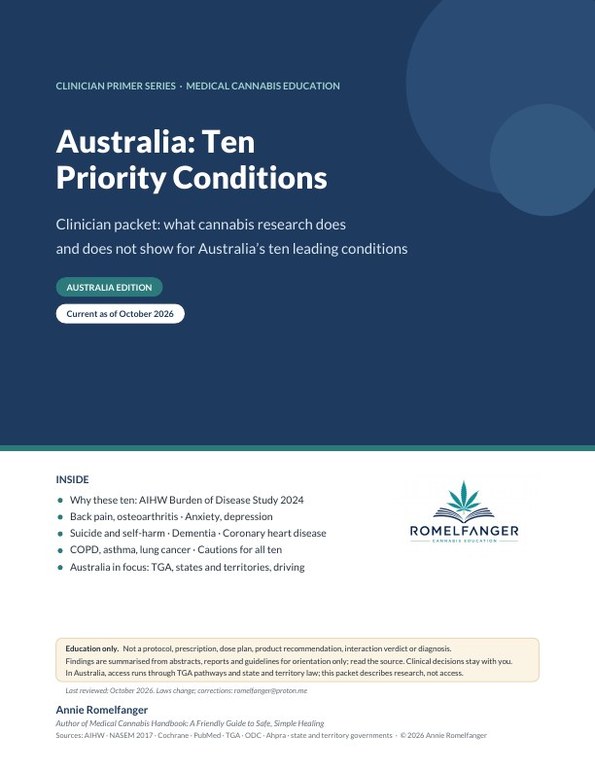
How medicinal cannabis access works in Australia (TGA pathways, pharmacy dispensing, state and territory rules) and what published research shows for the ten conditions that cause the most disease burden. Free to read. Education only.

Free guide. Nothing to buy.Laws checked against official sources on 30 October 2026.

Education only.

How access works in Australia

Summarised from Commonwealth, regulator, state and territory pages linked under each point. Rules differ between states and territories and change often; check the linked sources before acting.

  1. In forceSince 2016

    Federal framework

    The Narcotic Drugs Amendment Act 2016 amended the Narcotic Drugs Act 1967. Cultivating cannabis for medicinal purposes is allowed only under that Act, with a licence and permit from the Office of Drug Control. It does not allow growing for personal use.

    [2] Narcotic Drugs Amendment Act 2016 · [3] Office of Drug Control

  2. In forceCurrent TGA pages

    Approved and unapproved products

    Only Sativex (nabiximols) and Epidyolex (cannabidiol) are on the Australian Register of Therapeutic Goods. Most prescribed products are unapproved: the TGA has not assessed their quality, safety, efficacy or performance. They must meet the TGO 93 quality standard.

    [4] TGA: access pathways · [5] TGA: information for patients

  3. In forceCurrent TGA pages

    Special Access Scheme and Authorised Prescribers

    Doctors and nurse practitioners use the Special Access Scheme (Category A notification for seriously ill patients, or a Category B application) or become Authorised Prescribers. The TGA states there are no restrictions on the conditions for which a prescriber may apply.

    [4] TGA: access pathways · [6] TGA: accessing for a patient

  4. In forceCurrent TGA pages

    Pharmacy dispensing only

    Medicinal cannabis, including vaping products used to take it, may legally be obtained only from a pharmacy with a prescription from a doctor or nurse practitioner. Buying it from a tobacconist, vape shop, convenience store or an online store that is not a registered pharmacy is against the law.

    [5] TGA: information for patients

  5. In forceSince 31 January 2020

    ACT personal-use law

    In the ACT, adults 18 and over may possess up to 50 g of dried cannabis and grow up to two plants (no more than four per household, no artificial cultivation). Smoking in public and supplying cannabis remain offences, and Commonwealth law still applies. This is separate from medical access.

    Only in the ACT. Elsewhere in Australia, possession outside the medical pathways is an offence.

    [7] ACT NI2020-37 · [8] ACT drug law reform

  6. Check for updatesVictoria: since 1 March 2025

    Driving with THC

    The TGA states that a person can be charged if THC is found while driving, even with a prescription. In Victoria, any THC while driving is an offence and a prescription is no defence; since 1 March 2025 magistrates may choose not to cancel the licence of an unimpaired driver using prescribed cannabis. Tasmania has an exception for products obtained and taken in line with the Poisons Act 1971; driving while impaired remains an offence.

    Rules differ in each state and territory. Check the official page for yours before driving.

    [5] TGA: information for patients · [9] Transport Victoria · [10] Tasmanian Department of Health

  7. In force2025

    Prescribing guidance

    Ahpra and the national boards expect Schedule 8 medicinal cannabis to be prescribed with the same care as opioids: a full assessment, never as a first-line treatment, an exit strategy, informed consent about unapproved status and no prescribing without a real-time consultation.

    [11] Ahpra prescribing guidance

  8. Check for updatesConsultation closed 7 October 2025

    TGA review of unapproved products

    The TGA consulted on the safety and regulatory oversight of unapproved products, citing more than 1,000 products in supply and concern about higher-THC products. It received 786 submissions; stakeholders agreed the framework is not fit for purpose. The pages opened on 30 October 2026 did not report a resulting regulatory change.

    [12] TGA news, Aug 2025 · [13] TGA consultation outcome

Australia’s ten leading causes of disease burden

Where these numbers come from

The Australian Institute of Health and Welfare’s Burden of Disease Study 2024 measures healthy life lost to 220 diseases and injuries, from early death and from living with illness. The bars show age-standardised DALYs per 1,000 people. This shows where the burden lies, not whether cannabis helps: for four of the ten, the research is mainly about harm.

[1] AIHW Burden of Disease 2024

How to read the labels

  • Some trial evidence, usually modest Randomized trials show a benefit for some people, often small or limited to specific conditions.
  • Early, limited or mixed evidence A few small trials, conflicting results, or mainly observational data.
  • Little support, negative trials or risk only Few or no supportive trials, trials that found no benefit, or research only about harm.

Labels are our plain-language reading of the cited reviews and trials, not an official rating.

  1. 1Coronary heart disease8.9
  2. 2Back pain and problems8.6
  3. 3Anxiety disorders8.6
  4. 4Depressive disorders6.9
  5. 5Dementia6.5
  6. 6Suicide and self-inflicted injuries6.2
  7. 7Chronic obstructive pulmonary disease (COPD)5.7
  8. 8Asthma5.3
  9. 9Lung cancer4.6
  10. 10Osteoarthritis4.4

Next in the ranking: autism spectrum disorders, type 2 diabetes, rheumatoid arthritis, stroke and alcohol use disorders.

#1

Coronary heart disease

Little support, negative trials or risk only

Burden in Australia
Ranked 1 of 220 diseases and injuries: 8.9 healthy years of life lost per 1,000 people (age-standardised DALYs, 2024).
What the research shows
No trial was located showing that cannabis prevents or treats coronary heart disease. A 2025 meta-analysis of 24 observational studies estimated higher risks of acute coronary syndrome and cardiovascular death in cannabis users, and the American Heart Association notes that many concerning effects of cannabis are cardiovascular.
Keep in mind
  • The research here is about risk, not treatment.
  • Do not use cannabis in place of proven heart treatment.

Sources: [1] AIHW Burden of Disease 2024 · [14] Storck 2025 · [15] Page 2020
#2

Back pain and problems

Early, limited or mixed evidence

Burden in Australia
Ranked 2 of 220 diseases and injuries: 8.6 healthy years of life lost per 1,000 people (age-standardised DALYs, 2024). Back pain is the leading cause of non-fatal burden.
What the research shows
In a 2025 phase 3 trial in 820 adults with chronic low back pain, a cannabis extract reduced pain slightly more than placebo over 12 weeks (0.6 points on a 0–10 scale). A 2021 meta-analysis of 32 trials found a small benefit for chronic pain in general. No trial in disc herniation itself was found.
Keep in mind
  • Adverse events were more common than with placebo (83% vs 67%).
  • Exercise and physiotherapy have stronger evidence.

Sources: [1] AIHW Burden of Disease 2024 · [16] Karst 2025 · [17] Wang 2021

#3

Anxiety disorders

Early, limited or mixed evidence

Burden in Australia
Ranked 3 of 220 diseases and injuries: 8.6 healthy years of life lost per 1,000 people (age-standardised DALYs, 2024).
What the research shows
A 2019 Lancet Psychiatry review found very low-quality evidence of slight improvement with pharmaceutical THC, and a 2026 update of 54 trials found no significant effect on anxiety. Studies of cannabidiol alone are small.
Keep in mind
  • Anxiety is the most common psychiatric reason for prescribing in Australia, where the evidence is thin.
  • Cannabis use disorder can worsen anxiety.

Sources: [1] AIHW Burden of Disease 2024 · [18] Black 2019 · [19] Wilson 2026

#4

Depressive disorders

Little support, negative trials or risk only

Burden in Australia
Ranked 4 of 220 diseases and injuries: 6.9 healthy years of life lost per 1,000 people (age-standardised DALYs, 2024).
What the research shows
Reviews found scarce or no randomized evidence of benefit. In a pragmatic trial, adults given a medical cannabis card had no improvement in depressive symptoms and more cannabis use disorder.
Keep in mind
  • Cannabis use is linked with a small increased risk of developing depression.
  • Ask about suicidal thoughts. In Australia, call 000 in an emergency or Lifeline on 13 11 14.

Sources: [1] AIHW Burden of Disease 2024 · [18] Black 2019 · [20] Gilman 2022 · [21] NASEM 2017

#5

Dementia

Early, limited or mixed evidence

Burden in Australia
Ranked 5 of 220 diseases and injuries: 6.5 healthy years of life lost per 1,000 people (age-standardised DALYs, 2024).
What the research shows
A 2021 Cochrane review found little or no effect of cannabinoids on cognition. Small trials of agitation had mixed results; a 2026 meta-analysis of ten trials found no effect on total neuropsychiatric symptoms, and sedation was about twice as common.
Keep in mind
  • No trial shows cannabinoids help memory or thinking.
  • Watch for extra sleepiness, unsteadiness and falls.

Sources: [1] AIHW Burden of Disease 2024 · [22] Bosnjak 2021 · [23] Pan 2026

#6

Suicide and self-inflicted injuries

Little support, negative trials or risk only

Burden in Australia
Ranked 6 of 220 diseases and injuries: 6.2 healthy years of life lost per 1,000 people (age-standardised DALYs, 2024).
What the research shows
This is a risk question, not a treatment question. Meta-analyses link cannabis use, especially heavy use, with more suicidal thoughts and attempts, and an Australian twin study found more suicidal ideation in the twin with frequent use. No study tests cannabis as a treatment.
Keep in mind
  • If someone is at immediate risk, call 000. Lifeline (13 11 14) and the Suicide Call Back Service (1300 659 467) are available at any time.
  • Some links weaken after adjusting for depression and other factors.

Sources: [1] AIHW Burden of Disease 2024 · [24] Borges 2016 · [25] Agrawal 2017 · [26] Maffre 2025 · [27] healthdirect

#7

Chronic obstructive pulmonary disease (COPD)

Little support, negative trials or risk only

Burden in Australia
Ranked 7 of 220 diseases and injuries: 5.7 healthy years of life lost per 1,000 people (age-standardised DALYs, 2024).
What the research shows
Trials in advanced COPD found that cannabis did not ease breathlessness or improve exercise. The National Academies found substantial evidence that long-term cannabis smoking worsens respiratory symptoms and chronic bronchitis.
Keep in mind
  • Stopping smoking of any kind is the change with evidence behind it.
  • Quitting cannabis smoking is linked with better respiratory symptoms.

Sources: [1] AIHW Burden of Disease 2024 · [28] Abdallah 2018 · [21] NASEM 2017

#8

Asthma

Little support, negative trials or risk only

Burden in Australia
Ranked 8 of 220 diseases and injuries: 5.3 healthy years of life lost per 1,000 people (age-standardised DALYs, 2024).
What the research shows
No trial of cannabis as an asthma treatment was located. A 2025 meta-analysis of observational studies linked cannabis use with asthma, and frequent smoking was linked with wheeze and cough in a long-running New Zealand cohort.
Keep in mind
  • Avoid smoke of any kind.
  • Keep using asthma medicines and an up-to-date action plan.

Sources: [1] AIHW Burden of Disease 2024 · [29] Malvi 2025 · [30] Hancox 2015

#9

Lung cancer

Little support, negative trials or risk only

Burden in Australia
Ranked 9 of 220 diseases and injuries: 4.6 healthy years of life lost per 1,000 people (age-standardised DALYs, 2024).
What the research shows
No human trial was located showing that cannabinoids treat lung cancer; effects are limited to cell and mouse studies. ASCO (2024) recommends against cannabis as a cancer-directed treatment outside a trial. Some cannabinoids help chemotherapy nausea, but a Cochrane review found they do not reduce cancer pain.
Keep in mind
  • Avoid inhaled smoke of any kind.
  • Keep all cancer treatment and tell the cancer team about any cannabis use.

Sources: [1] AIHW Burden of Disease 2024 · [31] Braun 2024 · [32] Häuser 2023 · [21] NASEM 2017

#10

Osteoarthritis

Little support, negative trials or risk only

Burden in Australia
Ranked 10 of 220 diseases and injuries: 4.4 healthy years of life lost per 1,000 people (age-standardised DALYs, 2024).
What the research shows
Cannabidiol was no better than placebo in hand and knee osteoarthritis trials, and a 2026 meta-analysis of four randomized trials found no significant benefit for pain, quality of life or function.
Keep in mind
  • In one of the knee trials, adverse events and liver enzyme rises were more common with CBD.
  • Exercise and weight management have stronger evidence.

Sources: [1] AIHW Burden of Disease 2024 · [33] Vela 2022 · [34] Pramhas 2023 · [35] Mojoli 2025 · [36] Abafita 2026

Safety points for everyone

These apply whatever the reason for use.

  • Medicinal cannabis in Australia is legal only on prescription and from a pharmacy. Most products are unapproved and have not been assessed by the TGA for quality, safety or effectiveness. [5] TGA: information for patients
  • Cannabis use is linked with a higher risk of psychosis, especially with daily, high-potency use. Talk to a doctor first if you or a close relative have had psychosis or bipolar disorder. [21] NASEM 2017 · [37] Di 2019
  • A 2026 JAMA review estimates that about 29% of people using cannabis for medical reasons meet criteria for cannabis use disorder. [38] Hsu 2026
  • THC impairs driving, and in most of Australia driving with THC in your system is an offence even with a prescription. Check your state or territory’s rules. [39] Arkell 2020 · [9] Transport Victoria
  • Regular use can cause cannabinoid hyperemesis syndrome (cyclic vomiting); stopping cannabis appears to be the most effective treatment. [40] Sorensen 2017
  • Smoking cannabis during pregnancy is linked with lower birth weight. Talk to a doctor if you are pregnant or breastfeeding. [21] NASEM 2017
  • Cannabis can change the levels of some medicines. Ask a pharmacist to review your full medicine list, including CBD. [41] Nachnani 2024

Clinician packets

Optional paid packets for clinicians on the same ten conditions: per-condition research summaries, patient handoff sheets and a full verified source list. This guide stays free.

Sources

Laws, regulators and data

  1. Australian Institute of Health and Welfare (2024). Australian Burden of Disease Study 2024. Cat. no. BOD 40. Figure 5, leading causes by age-standardised DALY rate. DOI 10.25816/89ch-p422. www.aihw.gov.au
  2. Federal Register of Legislation. Narcotic Drugs Amendment Act 2016 (No. 12, 2016). www.legislation.gov.au
  3. Office of Drug Control. Medicinal cannabis (opened 30 October 2026). www.odc.gov.au
  4. Therapeutic Goods Administration. Medicinal cannabis: access pathways and usage data (last updated 1 July 2025). www.tga.gov.au
  5. Therapeutic Goods Administration. Medicinal cannabis information for patients (last updated 23 June 2025). www.tga.gov.au
  6. Therapeutic Goods Administration. Accessing medicinal cannabis for a patient (last updated 27 February 2026). www.tga.gov.au
  7. ACT Legislation Register. Drugs of Dependence (Personal Cannabis Use) Guidance Material 2020, NI2020-37 (commenced 31 January 2020). www.legislation.act.gov.au
  8. ACT Government. Drug law reform (opened 30 October 2026). www.act.gov.au
  9. Transport Victoria. Medicinal cannabis and driving laws in Victoria (opened 30 October 2026). transport.vic.gov.au
  10. Tasmanian Department of Health. Medicinal cannabis information for patients and the general public (opened 30 October 2026). www.health.tas.gov.au
  11. Ahpra and the Medical and Nursing and Midwifery Boards of Australia. Medicinal cannabis prescribing (opened 30 October 2026). www.ahpra.gov.au
  12. Therapeutic Goods Administration. Planned consultation to address growing safety concerns of unapproved medicinal cannabis products in Australia (news, 4 August 2025). www.tga.gov.au
  13. TGA consultation hub. Reviewing the safety and regulatory oversight of unapproved medicinal cannabis products (closed 7 October 2025; outcome opened 30 October 2026). consultations.tga.gov.au
  14. healthdirect Australia. Suicide prevention (opened 30 October 2026). www.healthdirect.gov.au

Studies (PubMed)

  1. Storck W, et al. Cardiovascular risk associated with the use of cannabis and cannabinoids: a systematic review and meta-analysis. Heart. 2025. PMID 40527600 · DOI 10.1136/heartjnl-2024-325429
  2. Page RL 2nd, et al. Medical Marijuana, Recreational Cannabis, and Cardiovascular Health: A Scientific Statement From the American Heart Association. Circulation. 2020. PMID 32752884 · DOI 10.1161/CIR.0000000000000883
  3. Karst M, et al. Full-spectrum extract from Cannabis sativa DKJ127 for chronic low back pain: a phase 3 randomized placebo-controlled trial. Nat Med. 2025;31(12):4189-4196. PMID 41023483 · DOI 10.1038/s41591-025-03977-0
  4. Wang L, et al. Medical cannabis or cannabinoids for chronic non-cancer and cancer related pain: a systematic review and meta-analysis of randomised clinical trials. BMJ. 2021;374:n1034. PMID 34497047 · DOI 10.1136/bmj.n1034
  5. Black N, et al. Cannabinoids for the treatment of mental disorders and symptoms of mental disorders: a systematic review and meta-analysis. Lancet Psychiatry. 2019;6:995-1010. PMID 31672337 · DOI 10.1016/S2215-0366(19)30401-8
  6. Wilson J, et al. The efficacy and safety of cannabinoids for the treatment of mental disorders and substance use disorders: a systematic review and meta-analysis. Lancet Psychiatry. 2026. PMID 41856154 · DOI 10.1016/S2215-0366(26)00015-5
  7. Gilman JM, et al. Effect of Medical Marijuana Card Ownership on Pain, Insomnia, and Affective Disorder Symptoms in Adults: A Randomized Clinical Trial. JAMA Netw Open. 2022;5:e222106. PMID 35302633 · DOI 10.1001/jamanetworkopen.2022.2106
  8. National Academies of Sciences, Engineering, and Medicine. The Health Effects of Cannabis and Cannabinoids: The Current State of Evidence and Recommendations for Research. National Academies Press; 2017. PMID 28182367 · DOI 10.17226/24625
  9. Bosnjak Kuharic D, et al. Cannabinoids for the treatment of dementia. Cochrane Database Syst Rev. 2021. PMID 34532852 · DOI 10.1002/14651858.CD012820.pub2
  10. Pan TJ, et al. Efficacy and Safety of Cannabinoids for Neuropsychiatric Symptoms of Dementia: A Systematic Review with Meta-analysis. CNS Drugs. 2026. PMID 41748849 · DOI 10.1007/s40263-026-01277-w
  11. Borges G, et al. A literature review and meta-analyses of cannabis use and suicidality. J Affect Disord. 2016. PMID 26872332 · DOI 10.1016/j.jad.2016.02.007
  12. Agrawal A, et al. Major depressive disorder, suicidal thoughts and behaviours, and cannabis involvement in discordant twins: a retrospective cohort study. Lancet Psychiatry. 2017. PMID 28750823 · DOI 10.1016/S2215-0366(17)30280-8
  13. Maffre Maviel G, et al. The role of depression in the relationship between cannabis use and suicidal behaviours: A systematic review and meta-analysis. Drug Alcohol Depend. 2025. PMID 40424695 · DOI 10.1016/j.drugalcdep.2025.112714
  14. Abdallah SJ, et al. Effect of Vaporized Cannabis on Exertional Breathlessness and Exercise Endurance in Advanced Chronic Obstructive Pulmonary Disease. A Randomized Controlled Trial. Ann Am Thorac Soc. 2018. PMID 30049223 · DOI 10.1513/AnnalsATS.201803-198OC
  15. Malvi A, et al. Cannabis consumption and risk of asthma: a systematic review and meta-analysis. BMC Pulm Med. 2025. PMID 39881272 · DOI 10.1186/s12890-025-03516-0
  16. Hancox RJ, et al. Effects of quitting cannabis on respiratory symptoms. Eur Respir J. 2015. PMID 25837035 · DOI 10.1183/09031936.00228914
  17. Braun IM, et al. Cannabis and Cannabinoids in Adults With Cancer: ASCO Guideline. J Clin Oncol. 2024. PMID 38478773 · DOI 10.1200/JCO.23.02596
  18. Häuser W, et al. Cannabis-based medicines and medical cannabis for adults with cancer pain. Cochrane Database Syst Rev. 2023. PMID 37283486 · DOI 10.1002/14651858.CD014915.pub2
  19. Vela J, et al. Cannabidiol treatment in hand osteoarthritis and psoriatic arthritis: a randomized, double-blind, placebo-controlled trial. Pain. 2022. PMID 34510141 · DOI 10.1097/j.pain.0000000000002466
  20. Pramhas S, et al. Oral cannabidiol (CBD) as add-on to paracetamol for painful chronic osteoarthritis of the knee: a randomized, double-blind, placebo-controlled clinical trial. Lancet Reg Health Eur. 2023. PMID 38033459 · DOI 10.1016/j.lanepe.2023.100777
  21. Mojoli A, et al. Effects and safety of a CBD-rich Cannabis sativa oil in knee osteoarthritis: a double-blind, randomized, placebo-controlled trial - CANOA - cannabis for osteoarthritis. Front Pharmacol. 2025. PMID 41487518 · DOI 10.3389/fphar.2025.1657065
  22. Abafita BJ, et al. Efficacy and Safety of Cannabis Extracts for the Treatment of Osteoarthritis: A Systematic Review and Meta-Analysis of Preclinical and Human Studies. Pain Res Manag. 2026. PMID 42515994 · DOI 10.1155/prm/3998239
  23. Di Forti M, et al. The contribution of cannabis use to variation in the incidence of psychotic disorder across Europe (EU-GEI): a multicentre case-control study. Lancet Psychiatry. 2019;6:427-436. PMID 30902669 · DOI 10.1016/S2215-0366(19)30048-3
  24. Hsu M, et al. Therapeutic Use of Cannabis and Cannabinoids: A Review. JAMA. 2026. PMID 41296368 · DOI 10.1001/jama.2025.19433
  25. Arkell TR, et al. Effect of Cannabidiol and Δ9-Tetrahydrocannabinol on Driving Performance: A Randomized Clinical Trial. JAMA. 2020. PMID 33258890 · DOI 10.1001/jama.2020.21218
  26. Sorensen CJ, et al. Cannabinoid Hyperemesis Syndrome: Diagnosis, Pathophysiology, and Treatment-a Systematic Review. J Med Toxicol. 2017;13:71-87. PMID 28000146 · DOI 10.1007/s13181-016-0595-z
  27. Nachnani R, et al. Systematic review of drug-drug interactions of delta-9-tetrahydrocannabinol, cannabidiol, and Cannabis. Front Pharmacol. 2024. PMID 38868665 · DOI 10.3389/fphar.2024.1282831

Education only. This page does not diagnose, recommend doses or products, or give drug-interaction verdicts. It is not legal advice. We do not sell, supply or refer to cannabis products. Always consult a qualified health practitioner. In an emergency in Australia, call 000.