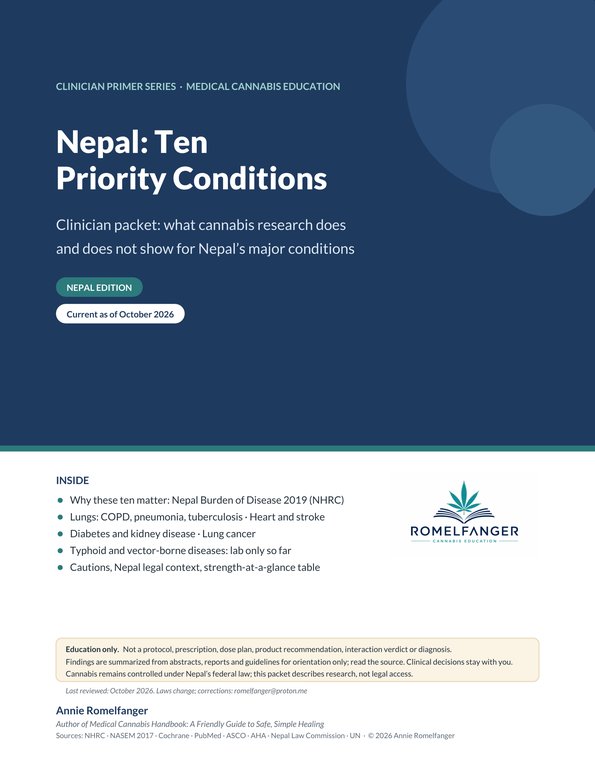
Cover of English - Nepal Priority Conditions Packet
English
New

$19

  • 13 pages
  • 82 numbered sources
  • English edition

What published research does and does not show for ten of Nepal’s leading health burdens, grouped as lungs (COPD, lower respiratory infections and pneumonia, tuberculosis), heart and brain (coronary artery disease, stroke), infections (typhoid, vector-borne diseases), metabolic and kidney (diabetes, chronic kidney disease) and trachea, bronchus and lung cancers. Most of the evidence is early laboratory work, with honest evidence ratings, safety cautions and Nepal legal context.

Written for Nepal. Most of the research on these conditions is early laboratory work, and nothing here says cannabis treats them. Education only: no doses, no product recommendations, no drug-interaction verdicts. For the law, check official government sources.

Checkout and download happen on Payhip, our store. Questions before you buy? Email [email protected].

Patient or caregiver? Start with our page for you.

What this packet covers

Ten priority conditions for Nepal, in the packet’s five groups. Each summary gives the evidence-strength label the packet assigns, the Nepal burden figures it cites, its key cautions and the number of sources it cites for that condition.

How the packet labels evidence strength

  • Some human evidence at least one controlled human study suggesting benefit for the condition or a symptom of it, usually small
  • Symptom-only human studies exist only for a symptom, and may be negative
  • Preclinical only cells or animals, no human studies
  • None located no qualifying study found in PubMed searches, Oct 23–24, 2026

Bottom line from the packet

For none of these ten conditions has a replicated human trial shown that cannabis or a cannabinoid treats the disease itself; the only disease-level signal is one small diabetes pilot. Other human evidence is limited to symptoms, is small, and is often negative. The strongest findings concern harm from smoking.

Lungs

COPD

Evidence strength: Symptom-only (negative)

Nepal burden
16.3% of all deaths in Nepal in 2019, up from 6.1% in 1990 (NHRC, GBD 2019). A Nepal systematic review linked household biomass smoke with airflow obstruction (odds ratio 2.06).
What the research shows
Small breathlessness trials in advanced COPD (vaporized cannabis, dronabinol) found no clinically meaningful benefit; a larger dronabinol trial in severe COPD is ongoing. The National Academies (2017) found substantial evidence that long-term cannabis smoking worsens respiratory symptoms and chronic bronchitis episodes, and moderate evidence that quitting improves symptoms.
Key cautions
  • Any inhaled smoke adds to existing household biomass and tobacco exposure.
  • Limited evidence links occasional cannabis smoking with COPD risk; a 2026 US survey linked daily inhaled use with COPD after adjusting for tobacco.

10 cited sources · packet refs [1, 2, 4, 13–19]

Lower respiratory infections and pneumonia

Evidence strength: None located

Nepal burden
4.5% of deaths; the leading communicable cause of death in Nepal (NHRC, GBD 2019).
What the research shows
No study was located testing cannabis or cannabinoids as a treatment for pneumonia or other lower respiratory infections. The evidence that exists concerns immune effects and infection risk.
Key cautions
  • Reviews describe cannabis smoke impairing the antibacterial and antifungal activity of lung macrophages.
  • An umbrella review found that prescription cannabidiol increased pneumonia in epilepsy trials (moderate certainty).

5 cited sources · packet refs [1, 2, 20–22]

Tuberculosis

Evidence strength: Preclinical only

Nepal burden
Drug-susceptible tuberculosis accounted for 3.5% of deaths (NHRC, GBD 2019).
What the research shows
Laboratory only: cannabidiol reduced intracellular M. tuberculosis in a cell model. No human treatment study was located.
Key cautions
  • Outbreaks have been traced to shared smoking in closed spaces and shared water pipes; in Thailand, smoking from a shared bong carried an odds ratio of 4.22 for active TB (case-control).
  • A systematic review judged the overall evidence linking cannabis use to TB weak and at serious risk of bias.

8 cited sources · packet refs [1, 23–29]

Heart and brain

Coronary artery disease

Evidence strength: None located

Nepal burden
Ischemic heart disease caused 12.3% of deaths in 2019; cardiovascular diseases overall, 24% (NHRC, GBD 2019).
What the research shows
No trial of cannabis for coronary disease was located. The research concerns risk: a 2025 meta-analysis of 24 observational studies estimated a risk ratio of 1.29 for acute coronary syndrome in cannabis users, while other meta-analyses found no significant association.
Key cautions
  • National Academies (2017): limited evidence that cannabis smoking may trigger acute myocardial infarction.
  • Across 47 RCTs, cannabinoids increased hypotension and orthostatic hypotension; 45% of those trials excluded people with heart disease.

7 cited sources · packet refs [1, 2, 30–34]

Stroke

Evidence strength: Symptom-only (negative)

Nepal burden
Part of the 24% of deaths from cardiovascular disease; the packet does not quote a stroke-specific share (NHRC, GBD 2019).
What the research shows
One small randomized trial (34 patients) found that nabiximols did not improve post-stroke spasticity versus placebo. No trial was located showing that cannabis prevents or treats stroke.
Key cautions
  • National Academies (2017): limited evidence of an association with ischemic stroke or subarachnoid hemorrhage.
  • Observational meta-analyses report higher odds of ischemic stroke with cannabis use (pooled OR 2.05); these studies cannot prove cause.

6 cited sources · packet refs [1, 2, 35–38]

Metabolic and kidney

Diabetes

Evidence strength: Some human evidence (one small pilot)

Nepal burden
A 2026 analysis of Nepal’s nationally representative STEPS 2019 survey found diabetes most common in the 45–59 age group; the packet does not quote a prevalence figure.
What the research shows
One small pilot RCT in type 2 diabetes found that THCV lowered fasting glucose versus placebo, while cannabidiol had no effect; this has not been confirmed in larger trials. Small trials for painful diabetic neuropathy are mixed, and population data showing lower diabetes odds in cannabis users are observational and highly heterogeneous.
Key cautions
  • Cannabis hyperemesis can mimic diabetic ketoacidosis (DKA) in people with type 1 diabetes.
  • National Academies (2017): limited evidence of an association with increased risk of prediabetes.
  • Dizziness and cognitive effects were common in the neuropathy trials.

9 cited sources · packet refs [2, 3, 11, 39–44]

Chronic kidney disease

Evidence strength: Symptom-only (negative)

Nepal burden
A Nepal meta-analysis found hypertension and diabetes to be the most common risk factors, with most patients identified at stage V.
What the research shows
A review found no studies of cannabis for symptom management in CKD. In one small randomized crossover trial of 14 people on hemodialysis, nabilone did not reduce itch versus placebo.
Key cautions
  • Kidney-outcome cohorts were mostly null; in one, 19 users with existing CKD had faster eGFR decline.
  • Half of surveyed CKD patients had used cannabis, but only 33.8% of them thought their doctor knew; the packet prompts a pharmacist review of the full medicine list.

9 cited sources · packet refs [12, 45–52]

Lung cancer

Trachea, bronchus and lung cancers

Evidence strength: Preclinical only (as treatment)

Nepal burden
A Nepal-specific figure was not verified for this packet, so none is quoted.
What the research shows
As a cancer treatment, the evidence is laboratory only: THC slowed growth or migration of lung cancer cells in cell and mouse studies. No human trial was located, and ASCO (2024) recommends against cannabis or cannabinoids as a cancer-directed treatment outside a clinical trial. Supportive-care evidence comes from cancer in general.
Key cautions
  • National Academies (2017): moderate evidence of no association between cannabis smoking and lung cancer incidence; a 2026 meta-analysis found an association in cohort studies but not in case-control studies.
  • A Cochrane review found moderate-certainty evidence that nabiximols and THC do not reduce cancer pain.

12 cited sources · packet refs [2, 53–63]

Infections

Typhoid (enteric fever)

Evidence strength: Preclinical only (related organisms)

Nepal burden
Hospital surveillance (2016–2019) estimated adjusted incidence of 330 per 100,000 person-years in Kathmandu and 268 in Kavrepalanchok, above the “high burden” threshold of 100.
What the research shows
Laboratory studies tested related Salmonella species, not S. Typhi, the cause of typhoid: cannabidiol extract inhibited S. Typhimurium and S. Newington in culture. No human study was located.
Key cautions
  • The bacteria developed resistance to cannabidiol in the lab.
  • Nothing in the packet suggests cannabis in place of proven antimicrobials or vaccines.

5 cited sources · packet refs [5, 64–67]

Vector-borne diseases

Evidence strength: Preclinical only / none located

Nepal burden
Nepal had its worst dengue outbreak in 2022; 34,564 kala-azar cases and 584 deaths were reported from 1980 to 2019; malaria is falling but clusters of rising cases persist; scrub typhus and Japanese encephalitis remain significant.
What the research shows
Malaria, Japanese encephalitis and kala-azar: laboratory studies only (a 2026 systematic review of eight preclinical malaria studies found some antimalarial activity, with most studies at unclear risk of bias). Dengue and scrub typhus: no study located.
Key cautions
  • Toxicity of the tested compounds is understudied.
  • Laboratory findings are a reason for research, not a basis for clinical use; nothing here replaces proven treatment, vaccines or vector control.

12 cited sources · packet refs [6–10, 68–74]

Source counts are the numbered sources the packet cites for each condition, including its Nepal burden figures; the packet lists 82 in total, with PubMed citations verified by PMID in October 2026. These summaries are condensed from the packet. Education only: no doses, product recommendations or drug-interaction verdicts, and nothing here says cannabis treats these conditions.