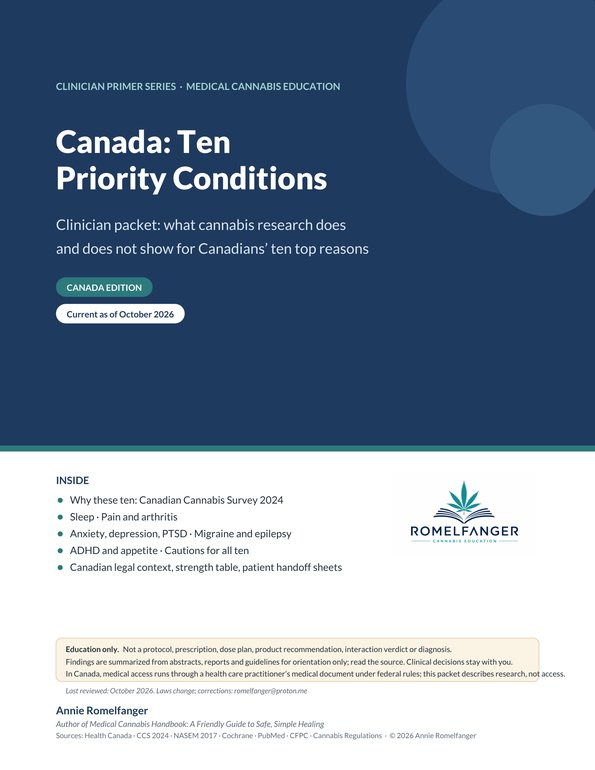
Cover of English - Canada Priority Conditions Packet
English
New

$19

  • 14 pages
  • 73 numbered sources
  • English edition

What published research does and does not show for the ten reasons Canadians most often gave for using cannabis for medical purposes (Canadian Cannabis Survey 2024): sleep, arthritis, chronic pain, anxiety, depression, headache or migraine, ADD or ADHD, seizures or epilepsy, PTSD and appetite. Plain evidence-strength labels, cautions for all ten, Canadian legal context (Cannabis Act, Part 14 of the Cannabis Regulations) and patient handoff sheets.

Written for Canada. Each condition gets a plain evidence label; for most of the ten the evidence is weak or mixed, and nothing here says cannabis cures them. Education only: no doses, no product recommendations, no drug-interaction verdicts. For the law, check official government sources.

Checkout and download happen on Payhip, our store. Questions before you buy? Email [email protected].

Patient or caregiver? Start with our page for you.

What this packet covers

The ten reasons Canadians most often give for using cannabis for medical purposes, in the packet’s five sections. Each summary gives the evidence-strength label the packet assigns, the Canadian survey figures it cites, its key cautions and the number of sources it cites for that condition.

How the packet labels evidence strength

  • Some human evidence randomized trials suggest a benefit for the condition or a key symptom, usually small
  • Mixed trials conflict, are very small, or show benefit on some outcomes but not others
  • Little or none controlled trials found no benefit, or only case reports and observational data exist

Bottom line from the packet

The reasons Canadians most often give for medical cannabis use (sleep, arthritis, pain, anxiety, depression) are mostly the ones with the weakest or most mixed trial evidence. The clearest trial results among the ten are for prescription cannabidiol in specific rare epilepsies and small average benefits in chronic, mainly neuropathic, pain; migraine has one promising acute trial. The harm evidence (psychosis, use disorder, hyperemesis, driving) applies to all ten.

Sleep

Sleep

Evidence strength: Mixed

Share of Canadian medical users
The most common reason: 47% of Canadians who used cannabis for medical purposes named sleep (Canadian Cannabis Survey 2024).
What the research shows
The National Academies (2017) found moderate evidence for short-term sleep outcomes in sleep disturbance linked to sleep apnea, fibromyalgia, chronic pain and MS. The 2026 Cochrane review found that medical cannabis may have little to no meaningful effect in insomnia (very low certainty), while a meta-analysis found a small improvement in sleep quality in chronic pain. Small two-week insomnia trials reported better sleep.
Key cautions
  • In a pragmatic trial, adults given a medical cannabis card reported fewer insomnia symptoms but more cannabis use disorder symptoms.
  • The packet asks whether nightly use is becoming daily use, and about next-day sleepiness and driving in the morning.

9 cited sources · packet refs [1, 10–17]

Pain and arthritis

Arthritis

Evidence strength: Mixed

Share of Canadian medical users
Named by 37% of medical users (CCS 2024).
What the research shows
A 2016 review of rheumatic diseases found only four small, short studies. In one rheumatoid arthritis trial of 58 patients, nabiximols improved pain on movement and disease-activity scores, with small and variable differences. In osteoarthritis, cannabidiol was no better than placebo in hand or knee trials, and a 2026 meta-analysis found no significant benefit.
Key cautions
  • In one knee trial, cannabidiol gave more adverse events and liver enzyme rises.
  • The packet asks whether exercise, weight management, physiotherapy and standard analgesia have been offered.

7 cited sources · packet refs [1, 26–31]

Chronic pain (with acute pain)

Evidence strength: Some human evidence (small)

Share of Canadian medical users
Chronic pain was named by 34% of medical users, and acute pain by a further 17% (CCS 2024). In a survey of 2,697 authorized patients, pain and anxiety were the most common symptoms reported.
What the research shows
A 2021 BMJ meta-analysis of 32 trials found a small increase in the share of patients reaching a meaningful improvement in pain; a 2026 update found small short-term improvements, mainly in neuropathic pain, with more adverse events. In acute pain, trials mostly found cannabinoids equal to placebo.
Key cautions
  • In a four-year cohort of 1,514 people prescribed opioids, there was no evidence that cannabis use reduced pain or had an opioid-sparing effect.
  • The 2018 Cochrane review on neuropathic pain concluded that potential benefits might be outweighed by potential harms.

11 cited sources · packet refs [1, 4, 10, 18–25]

Anxiety, depression and PTSD

Anxiety

Evidence strength: Mixed

Share of Canadian medical users
Named by 25% of medical users (CCS 2024 figure; the survey summary text says 26%). In 37,303 authorized patients in Ontario and Alberta, 90.8% of those followed had no change in anxiety scores.
What the research shows
The National Academies (2017) found limited evidence for cannabidiol in a public-speaking test in social anxiety. A 2026 update of 54 trials found no significant effect on anxiety; a 2024 cannabidiol meta-analysis found a large effect but urged caution because of small samples, and a 2025 review found a high risk of bias. In 50 women with advanced breast cancer, cannabidiol missed its primary anxiety endpoint.
Key cautions
  • A 2019 review found that pharmaceutical THC slightly improved anxiety only on very low-quality evidence, with more adverse events.
  • The packet asks about personal or family history of psychosis or bipolar disorder, and notes that use disorder can worsen anxiety outcomes.

8 cited sources · packet refs [1, 5, 10, 32–36]

Depression

Evidence strength: Little or none

Share of Canadian medical users
Named by 22% of medical users (CCS 2024).
What the research shows
Reviews found scarce or no randomized evidence of benefit for depression. In a pragmatic trial, adults given a medical cannabis card had no improvement in depressive symptoms and more cannabis use disorder.
Key cautions
  • The National Academies (2017) found moderate evidence of a small increased risk of developing depressive disorders with cannabis use.
  • Adolescent use is linked with later depression and suicidal ideation.

6 cited sources · packet refs [1, 10, 16, 32, 33, 37]

PTSD

Evidence strength: Mixed

Share of Canadian medical users
Named by 12% of medical users (CCS 2024).
What the research shows
In 10 Canadian military personnel, nabilone reduced trauma-related nightmares more than placebo. In the first randomized trial of smoked cannabis for PTSD, no active preparation beat placebo. Reviews found insufficient evidence and no major benefit for overall symptoms.
Key cautions
  • The 2023 US VA/DoD guideline recommends against cannabis or cannabis-derived products for PTSD.
  • In people with both PTSD and cannabis use disorder, stopping cannabis was linked to fewer PTSD symptoms.

8 cited sources · packet refs [1, 10, 38–43]

Migraine and epilepsy

Headache or migraine

Evidence strength: Some human evidence (one acute trial)

Share of Canadian medical users
Named by 15% of medical users (CCS 2024).
What the research shows
In a 2026 randomized crossover trial (92 participants, 247 attacks), vaporized THC plus CBD beat placebo for pain relief and pain freedom at two hours; CBD-dominant cannabis did not. The rest of the evidence is observational, and reviews call it promising but low quality.
Key cautions
  • Medication-overuse headache was more common in cannabis users.
  • The packet asks how many days a month acute headache medication is used.

5 cited sources · packet refs [1, 44–47]

Seizures or epilepsy

Evidence strength: Some human evidence (prescription CBD, specific syndromes)

Share of Canadian medical users
Named by 12% of medical users (CCS 2024).
What the research shows
Added to existing seizure medicines, prescription cannabidiol reduced convulsive seizures in Dravet syndrome, drop seizures in Lennox-Gastaut syndrome in two trials, and seizures in tuberous sclerosis complex. These results apply to the purified products tested, not to cannabis in general. The National Academies’ 2017 conclusion of insufficient evidence predates these trials.
Key cautions
  • In tests of non-prescription CBD products, labels were often inaccurate and THC was found in 6 of 11 oils.
  • Blood levels of several seizure medicines changed with cannabidiol; the authors stress monitoring levels and liver tests.

10 cited sources · packet refs [1, 10, 48–55]

ADHD and appetite

ADD or ADHD

Evidence strength: Little or none

Share of Canadian medical users
Named by 15% of medical users (CCS 2024).
What the research shows
In a pilot trial of 30 adults, a cannabinoid spray missed its primary cognitive endpoint. A 2023 scoping review of 39 studies found most reported worse or unchanged symptoms and did not recommend cannabis for ADHD. In 223 adults with chronic pain, medical cannabis use was not associated with change in moderate or severe ADHD symptoms.
Key cautions
  • The National Academies (2017) found moderate evidence that acute cannabis use impairs learning, memory and attention.
  • The packet asks whether cannabis use is affecting school, work or driving.

7 cited sources · packet refs [1, 10, 32, 33, 56–58]

Appetite

Evidence strength: Mixed

Share of Canadian medical users
Named by 12% of medical users (CCS 2024).
What the research shows
In AIDS-related weight loss, dronabinol improved appetite (38% vs 8%). In cancer, megestrol acetate improved appetite more than dronabinol, and in 243 patients with cancer cachexia, cannabis extract and THC did not differ from placebo; a pilot trial in lung cancer found nabilone increased caloric intake. Evidence in anorexia nervosa is low quality.
Key cautions
  • The National Academies (2017) found no or insufficient evidence for cancer-associated anorexia cachexia syndrome and anorexia nervosa.
  • The packet asks what is causing the weight loss, and whether nutrition support has been offered.

8 cited sources · packet refs [1, 10, 17, 59–63]

Source counts are the numbered sources the packet cites in each condition’s section, including the Canadian Cannabis Survey 2024 [1]; the packet lists 73 in total, with PubMed citations verified by PMID in October 2026. Shares are self-reported reasons among people who used cannabis for medical purposes, and more than one reason could be chosen. These summaries are condensed from the packet. Education only: no doses, product recommendations or drug-interaction verdicts.