← Argentina

Argentina edition

English - Argentina Priority Conditions Packet

Education only: no diagnosis, dosing or drug-interaction advice. Always consult a clinician.

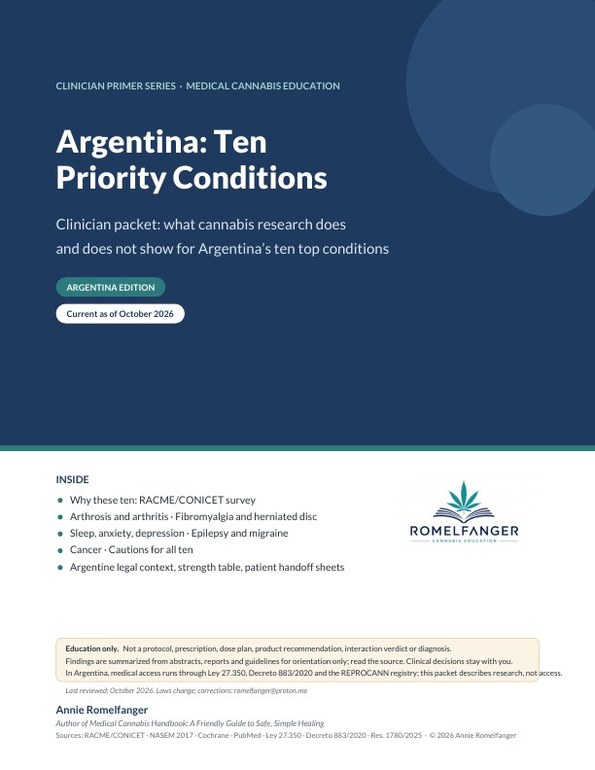
Cover of English - Argentina Priority Conditions Packet
English
New

$19

  • 14 pages
  • 81 numbered sources
  • English edition

What published research does and does not show for the ten diseases or disorders most often named in Argentina’s RACME/CONICET survey on therapeutic and medicinal cannabis use: arthrosis, sleep, fibromyalgia, anxiety, depression, epilepsy, herniated disc, arthritis, migraine and cancer. Plain evidence-strength labels, cautions for all ten, Argentine legal context (Ley 27.350, Decreto 883/2020, REPROCANN) and patient handoff sheets.

Written for Argentina. Each condition gets a plain evidence label; for most of the ten the evidence is weak or mixed, and nothing here says cannabis cures them. Education only: no doses, no product recommendations, no drug-interaction verdicts. For the law, check official government sources.

Checkout and download happen on Payhip, our store. Questions before you buy? Email [email protected].

Patient or caregiver? Start with our page for you.

What this packet covers

The ten diseases or disorders most often named in Argentina’s RACME/CONICET survey on therapeutic and medicinal cannabis use, in the packet’s five sections. Each summary gives the evidence-strength label the packet assigns, the survey figures it cites, its key cautions and the number of sources it cites for that condition.

How the packet labels evidence strength

  • Some human evidence randomized trials suggest a benefit for the condition or a key symptom, usually small
  • Mixed trials conflict, are very small, or show benefit on some outcomes but not others
  • Little or none controlled trials found no benefit, or only case reports and observational data exist

Bottom line from the packet

The conditions most often named in Argentina (arthrosis, sleep, fibromyalgia, anxiety, depression) are mostly the ones with the weakest or most mixed trial evidence. The clearest trial results among the ten are for prescription cannabidiol in specific rare epilepsies and for chemotherapy nausea; migraine has one promising acute trial. Argentine product tests show that labels and contents often differ. The harm evidence (psychosis, use disorder, hyperemesis, driving) applies to all ten.

Arthrosis and arthritis

Arthrosis (osteoarthritis)

Evidence strength: Little or none

Share of survey answers
104 (11%) of the 951 disease answers in the RACME/CONICET survey (Dec 2020–Jan 2021), ranked 1 of ten. The most common condition named.
What the research shows
A 2016 review of rheumatic diseases found only four small, short studies, and another found no randomized trial in osteoarthritis at all. Since then, cannabidiol was no better than placebo in hand osteoarthritis or in two knee trials, and a 2026 meta-analysis of four randomized trials found no significant benefit for pain, quality of life or function.
Key cautions
  • In one knee trial, cannabidiol gave more adverse events and liver enzyme rises.
  • The packet asks whether exercise, weight management, physiotherapy and standard treatment have been offered, and how benefit will be measured.

7 cited sources · packet refs [1, 9–14]

Arthritis

Evidence strength: Mixed (one small trial)

Share of survey answers
45 (5%) of the 951 disease answers in the RACME/CONICET survey (Dec 2020–Jan 2021), ranked 8 of ten.
What the research shows
In one rheumatoid arthritis trial of 58 patients, nabiximols improved pain on movement, pain at rest and disease activity scores, with small and variable differences. No other randomized trial in inflammatory arthritis was found in the reviews cited.
Key cautions
  • Cannabis has not been shown to change the course of rheumatoid arthritis; the packet asks whether disease-modifying treatment is in place.
  • The packet asks whether any CBD product is affecting liver tests.

4 cited sources · packet refs [1, 9, 10, 15]

Fibromyalgia and herniated disc

Fibromyalgia

Evidence strength: Mixed

Share of survey answers
92 (10%) of the 951 disease answers in the RACME/CONICET survey (Dec 2020–Jan 2021), ranked 3 of ten.
What the research shows
Cochrane (2016) found only two nabilone trials (72 people), with very low-quality evidence. Small trials were mixed: single inhalations did not beat placebo in 20 people, while a THC-rich oil improved questionnaire scores in 17 women. A 2026 meta-analysis of 12 studies, mostly observational, found lower pain scores on low-certainty evidence with considerable heterogeneity.
Key cautions
  • Dizziness, dry mouth and drowsiness were common in the 2026 meta-analysis.
  • In 31 people with insomnia, nabilone improved sleep more than amitriptyline, with no effect on pain or mood and more adverse events.

6 cited sources · packet refs [1, 16–20]

Herniated disc

Evidence strength: Mixed

Share of survey answers
50 (5%) of the 951 disease answers in the RACME/CONICET survey (Dec 2020–Jan 2021), ranked 7 of ten.
What the research shows
We found no randomized trial in disc herniation itself; the closest evidence is for chronic low back pain and chronic pain in general. A 2021 BMJ meta-analysis of 32 trials (5,174 patients) found a small increase in the share of patients reaching a meaningful improvement in pain; a 2026 update found small short-term improvements, mainly in neuropathic pain, with more adverse events. The 2026 Cochrane update on neuropathic pain found no clear evidence for THC-dominant medicines. In a 2025 phase 3 trial in 820 adults with chronic low back pain, a cannabis extract reduced pain by 0.6 points more than placebo on a 0–10 scale.
Key cautions
  • Adverse events were more frequent with the extract in the low back pain trial (83.3% vs 67.3%), mostly mild to moderate.
  • The packet asks about red flags or nerve deficits that need investigation first, and whether exercise and physiotherapy have been offered.

11 cited sources · packet refs [1, 10, 21–29]

Sleep, anxiety and depression

Sleep

Evidence strength: Mixed

Share of survey answers
98 (10%) of the 951 disease answers in the RACME/CONICET survey (Dec 2020–Jan 2021), ranked 2 of ten. The second most common condition named.
What the research shows
The National Academies (2017) found moderate evidence for short-term sleep outcomes in sleep disturbance linked to sleep apnea, fibromyalgia, chronic pain and MS. The 2026 Cochrane review found that medical cannabis may have little to no meaningful effect in insomnia (very low certainty), while a meta-analysis of 39 trials found a small improvement in sleep quality in chronic pain. Small two-week insomnia trials reported better sleep; a 2026 JAMA review says trial evidence does not support cannabis for insomnia.
Key cautions
  • In a pragmatic trial, adults given a medical cannabis card reported fewer insomnia symptoms but more cannabis use disorder symptoms.
  • The packet asks what is driving the poor sleep (pain, anxiety, sleep apnea, shift work, alcohol) and whether cognitive behavioural therapy for insomnia has been offered.

9 cited sources · packet refs [1, 23, 30–36]

Anxiety

Evidence strength: Mixed

Share of survey answers
64 (7%) of the 951 disease answers in the RACME/CONICET survey (Dec 2020–Jan 2021), ranked 4 of ten.
What the research shows
The National Academies (2017) found limited evidence for cannabidiol in a public speaking test in social anxiety disorders. A 2019 Lancet Psychiatry review found very low-quality evidence of slight improvement with pharmaceutical THC; a 2026 update of 54 trials found no significant effect on anxiety. A 2024 meta-analysis of cannabidiol (316 participants) found a large effect but urged caution because of small samples, and a 2025 review found a high risk of bias. In 50 women with advanced breast cancer, cannabidiol missed its primary anxiety endpoint.
Key cautions
  • Cannabis use disorder can worsen anxiety and depression outcomes; the packet asks whether use is rising.
  • The packet asks about any personal or family history of psychosis or bipolar disorder, and whether evidence-based therapy has been offered.

7 cited sources · packet refs [1, 23, 37–41]

Depression

Evidence strength: Little or none

Share of survey answers
55 (6%) of the 951 disease answers in the RACME/CONICET survey (Dec 2020–Jan 2021), ranked 5 of ten.
What the research shows
The National Academies (2017) found limited evidence that cannabinoids are ineffective for depressive symptoms in chronic pain or MS. Reviews found scarce or no randomized evidence of benefit for depression, and in a pragmatic trial adults given a medical cannabis card had no improvement in depressive symptoms.
Key cautions
  • The National Academies found moderate evidence of a small increased risk of developing depressive disorders with cannabis use; adolescent use is linked with later depression and suicidal ideation.
  • The packet asks about suicidal thoughts and whether psychotherapy or medication has been offered and documented.

6 cited sources · packet refs [1, 23, 35, 37, 38, 42]

Epilepsy and migraine

Epilepsy

Evidence strength: Some human evidence (prescription CBD, specific syndromes)

Share of survey answers
50 (5%) of the 951 disease answers in the RACME/CONICET survey (Dec 2020–Jan 2021), ranked 6 of ten. In Córdoba, refractory epilepsy was the most common use among 37 people interviewed (27%).
What the research shows
The National Academies (2017) conclusion of insufficient evidence predates the main trials. Added to existing seizure medicines, prescription cannabidiol reduced convulsive seizures in Dravet syndrome, drop seizures in Lennox-Gastaut syndrome in two trials and seizures in tuberous sclerosis complex; a 2019 review found that cannabidiol probably reduces seizure frequency in children with drug-resistant epilepsy. These results apply to the purified products tested, not to cannabis in general. The Ministry of Health states that one cannabidiol-based product has been registered for epileptic encephalopathies since October 2020.
Key cautions
  • Blood levels of several seizure medicines changed with cannabidiol in an expanded-access study; the authors stress monitoring levels and liver tests.
  • In Córdoba, 15% of 48 oils analysed had no quantifiable CBD or THC, so many oils people used had little or no measurable cannabinoid.

12 cited sources · packet refs [1, 4, 23, 43–51]

Migraine

Evidence strength: Some human evidence (one acute trial)

Share of survey answers
44 (5%) of the 951 disease answers in the RACME/CONICET survey (Dec 2020–Jan 2021), ranked 9 of ten.
What the research shows
In a 2026 randomized crossover trial (92 participants, 247 attacks), vaporized THC plus CBD beat placebo for pain relief (67.2% vs 46.6%) and pain freedom (34.5% vs 15.5%) at two hours; CBD-dominant cannabis was not better than placebo. Other evidence is observational, and reviews call it promising but low quality.
Key cautions
  • In a case-referent study, medication-overuse headache was more common in cannabis users (adjusted OR 6.3).
  • The packet asks how many days a month acute medication is used.

6 cited sources · packet refs [1, 52–56]

Cancer

Cancer

Evidence strength: Depends on the symptom

Share of survey answers
40 (4%) of the 951 disease answers in the RACME/CONICET survey (Dec 2020–Jan 2021), ranked 10 of ten.
What the research shows
No anti-tumour evidence: the National Academies (2017) found no or insufficient evidence for cancers, and ASCO (2024) recommends against cannabis or cannabinoids as a cancer-directed treatment outside a clinical trial. For symptoms, results depend on the symptom: chemotherapy nausea has the clearest evidence (complete response rose from 8% to 24% when oral THC:CBD was added to guideline antiemetics in a 147-participant trial), cancer pain trials were negative, and cancer cachexia trials did not beat placebo.
Key cautions
  • Regular use can itself cause cyclic vomiting (hyperemesis); stopping cannabis appears to be the most effective treatment.
  • The packet asks whether the patient believes cannabis treats the cancer itself, and whether that has been discussed alongside oncology and palliative care.

16 cited sources · packet refs [1, 23, 57–70]

Source counts are the numbered sources the packet cites in each condition’s section, including the RACME/CONICET survey report [1]; the packet lists 81 in total, with PubMed citations verified by PMID in October 2026. Shares are of 951 open, self-reported answers in a non-probability online survey, and more than one condition could be named. These summaries are condensed from the packet. Education only: no doses, product recommendations or drug-interaction verdicts.